erp integration
order processing automation
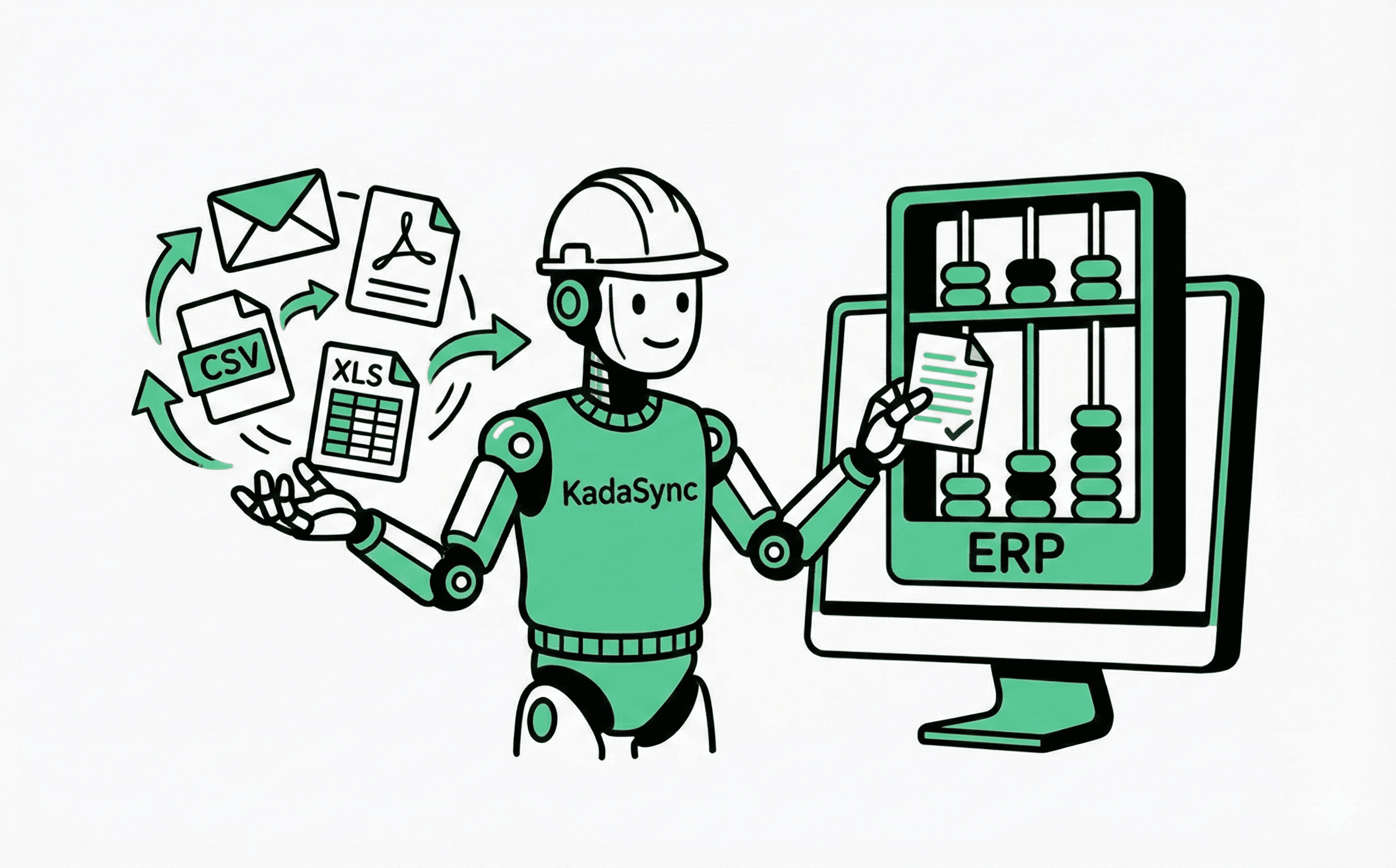
For businesses in Switzerland and the DACH region, Abacus is more than just software. It is the gold standard—the financial and operational backbone that thousands of companies rely on. It is robust, secure, and incredibly powerful.
However, for modern companies trying to automate their workflows, integrating with an established ERP giant like Abacus presents a unique set of challenges. Most modern startups and AI tools speak the language of instant APIs and flexible data, while established enterprise systems demand structure, protocol, and precision.
At KadaSync, we bridge this gap. We turn messy inboxes into clean ERP orders by using AI to extract data from PDFs and Excels, then piping that data directly into Abacus. But getting a fluid, AI-driven engine to talk to a rigid ERP architecture requires deep technical engineering.
Here is how we solved the technical complexities of integrating with Switzerland’s favorite ERP.
1. The Clash of Eras: REST vs. SOAP
To understand the integration challenge, you have to look at the language the systems speak. Modern applications usually communicate via REST APIs, which are lightweight and flexible—like sending a quick text message.
Abacus, prioritizing stability and security, relies on SOAP (Simple Object Access Protocol) and XML.
While modern REST APIs often rely on standard JSON formats, working with SOAP involves wrapping data in a strict "XML Envelope". It is not just about avoiding syntax errors; it is about adhering to a rigid contract. The structure allows for strictly defined, complex operations, but it creates a heavy overhead compared to modern lightweight APIs.
Engineered for Performance: To handle this, we moved beyond standard interpreted languages. We utilize Rust in our backend to handle the heavy lifting of XML processing. Rust’s memory safety and speed allow us to generate these complex, verified SOAP envelopes in milliseconds, ensuring that every request is addressed perfectly before it leaves our system.
2. The "Mandant" Challenge: Accessing the Right Room
One of the most critical aspects of the Abacus architecture is its "Mandant" (Client/Tenant) structure.
In many systems, a simple login (Username + Password) grants access. In Abacus, that is not enough. Because the system is Multi-Tenant, every interaction must be authenticated against a specific Mandant. It’s not enough to have the key to the building; you need to know exactly which office door to open.
Our system manages this complex handshake natively within our architecture. We designed our session management to be "Mandant-aware" at its core. This ensures that every digital request—whether it’s checking a price or posting an order—carries the correct "Mandant ID," ensuring data is always routed to the correct business unit without manual intervention.
3. The Complexity of "Stateful" Conversations
Perhaps the biggest technical hurdle in this integration is Tokenization and Session Management.
Modern web traffic is often "stateless"—you ask a question, get an answer, and the connection closes. Abacus SOAP APIs, however, often require a "stateful" conversation where one message is strictly tied to the previous one.
This creates a complex dependency chain:
Login: We initiate a session and receive a secure Token.
Action: We must attach that specific Token to the next request (e.g., "Find Customer").
Polling: Many Abacus operations are asynchronous. When we send a large batch of data, the server often replies with "Processing...".
We cannot just walk away. We developed a robust Polling Engine that keeps the conversation alive. It uses the active Token to repeatedly query the server until the job is done, handling token refreshes and timeouts in the background so the user never experiences a drop in connection.
4. Translating the Language of Data (Sync & Cache)
Finally, there is the challenge of data matching. Abacus effectively has its own internal language, often reflecting its Swiss-German heritage with field names like ADNR (Adressnummer) or IANR (Interne Artikelnummer).
A modern AI system extracting data from an email needs to know that "Item SKU 123" maps to "IANR 123" within "Mandant 5".
The Speed Solution: SOAP APIs can be slower than modern search indexing. To solve this, we implemented a "Sync & Cache" strategy. Instead of hammering the Abacus server with a slow live search every time you type a letter, we fetch the relevant data and index it into a lightning-fast local search engine. This allows us to map the messy reality of email data to the precise codes Abacus requires—instantly.
Why This Matters: Turning Messy Emails into Clean Orders
We solved these deep technical challenges so you can solve a business one: the high cost of manual order entry.
Managing hundreds of orders via email isn't sustainable. When critical data is trapped in attachments, your business suffers from format chaos (PDFs, Word docs, CSVs) and the risk of human error.
KadaSync acts as the universal translation layer between your inbox and Abacus:
Universal Order Ingestion: We automatically capture order data from a wide range of email formats and attachments, eliminating the need for manual sorting.
AI-Powered Extraction: Our engine identifies key details like item numbers, quantities, and prices, understanding structure and context.
Seamless Integration: Validated, structured data flows directly into Abacus via the robust integration described above.
Struggling with your own ERP integration?
We have been there. If you need technical expertise in navigating SOAP APIs or legacy ERP connections, our team is ready to help.