erp integration
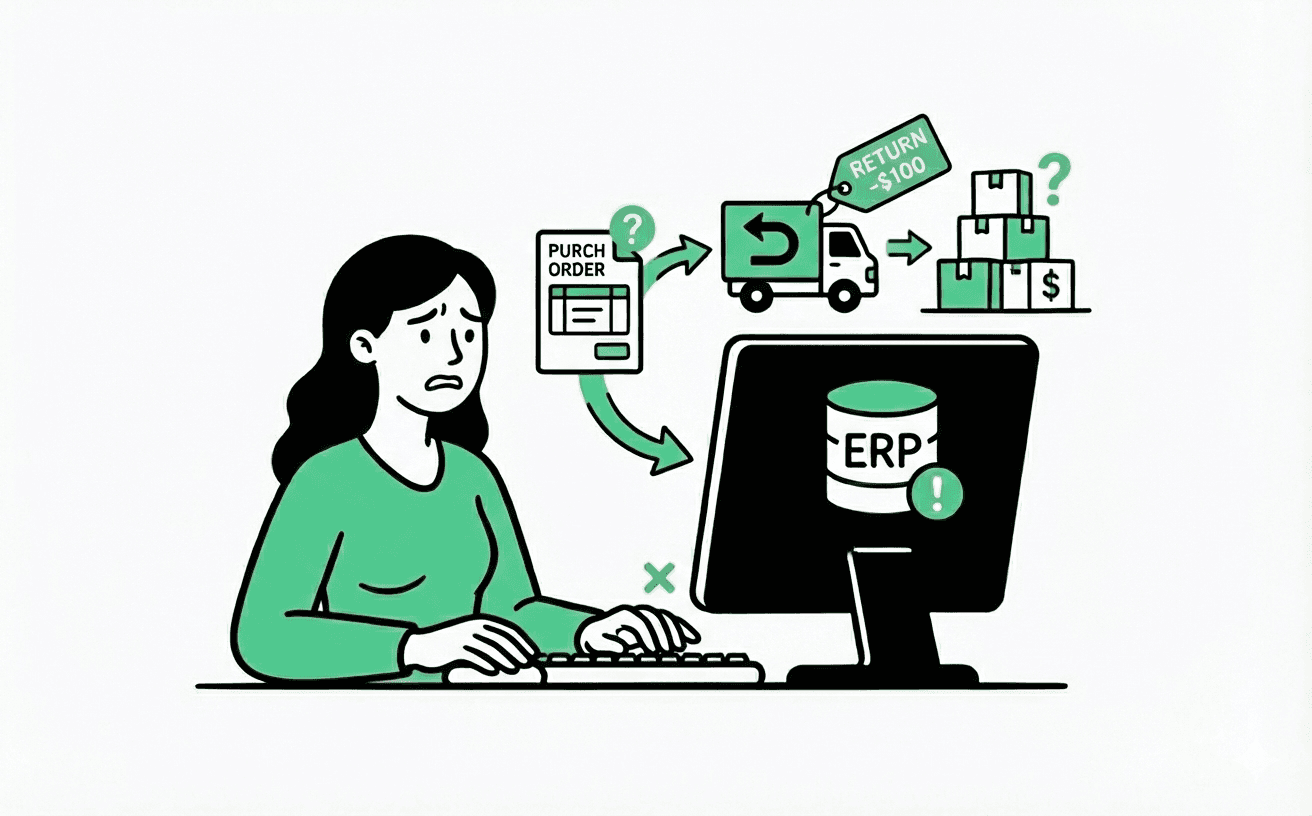
When businesses calculate the cost of processing customer orders, they usually look at one number: the salary of the person doing the typing.
If you have two administrators spending 20 hours a week entering Purchase Orders (POs) into your ERP, the math seems simple. You multiply their hourly rate by the hours worked, and you have your "cost of data entry."
But this is a dangerous oversimplification.
The salary cost is just the tip of the iceberg. The real damage to your bottom line happens beneath the surface, in what we call the "Hidden Costs of Manual Entry." These costs don't show up on a payroll report, but they are silently eating away at your profit margins.
1. The "Fat-Finger" Tax (The Cost of Errors)
Human error is inevitable. Even the most diligent data entry clerk has an error rate between 1% and 4%. When a human is tired, distracted, or rushing to clear a Monday morning backlog, that rate spikes.
In a spreadsheet, a typo is annoying. In an ERP system, a typo is expensive.
Consider the 1-10-100 Rule of quality management:
$1: The cost to verify data accuracy before it enters the system (Automation/Prevention).
$10: The cost to fix an error after it’s in the ERP but before it ships (Correction).
$100: The cost if the error reaches the customer (Failure).
When a clerk accidentally types SKU "A-123" (a $50 part) instead of "A-132" (a $500 part), or enters a quantity of 100 instead of 10, the ripple effect triggers the "Fat-Finger Tax":
Reverse Logistics: You pay for shipping the wrong item out and shipping it back.
Restocking Fees: Labor is wasted inspecting and re-shelving returned goods.
Inventory Ghosting: Your ERP says you have stock that you don't, leading to promised orders you can't fulfill later.
2. The Speed Tax (The Order-to-Cash Lag)
In the manual world, an order is not "received" when it hits the inbox. It is only "received" when a human opens that email.
If an order arrives at 4:55 PM on a Friday, it sits in the inbox until 9:00 AM Monday. That is a 64-hour delay before the order even exists in your ERP system. This lag extends your Order-to-Cash cycle—the time it takes from receiving an order to getting paid for it.
Manual entry creates a bottleneck. Your warehouse might be ready to pick, and your trucks might be ready to leave, but if the paperwork is stuck in an inbox, the inventory doesn't move.
3. The Opportunity Cost (What You Are NOT Doing)
Perhaps the most expensive hidden cost is the waste of human talent.
If your Customer Service Representatives (CSRs) or Inside Sales team are spending 30% of their day manually copying data from PDFs to ERPs, that is 30% of their day they are not generating revenue.
Every minute spent on data entry is a minute lost on:
Upselling and Cross-selling: Calling a customer to suggest a complementary product.
Relationship Building: Solving complex client issues that require empathy (something AI can't do).
Process Improvement: optimizing internal workflows.
You are effectively paying high-value employees to do low-value work.
Breaking the Cycle with Automation
The only way to eliminate these hidden costs is to remove the manual touchpoint.
KadaSync acts as a firewall against these costs:
Eliminate the Fat-Finger Tax: Our AI extracts data with machine precision. If a price or SKU doesn't match your ERP records, it is flagged for review before it enters the system (the $1 stage).
Erase the Speed Tax: Automated ingestion works 24/7. An order sent on Friday evening is processed and ready for the Monday morning shift instantly.
Reclaim Opportunity: Your team stops being "data processors" and starts being "profit generators."
Manual data entry isn't just a boring task; it is a financial leak. By automating the flow from inbox to ERP, you don't just save time—you stop paying the hidden taxes that hold your business back.