erp integration
business efficiency
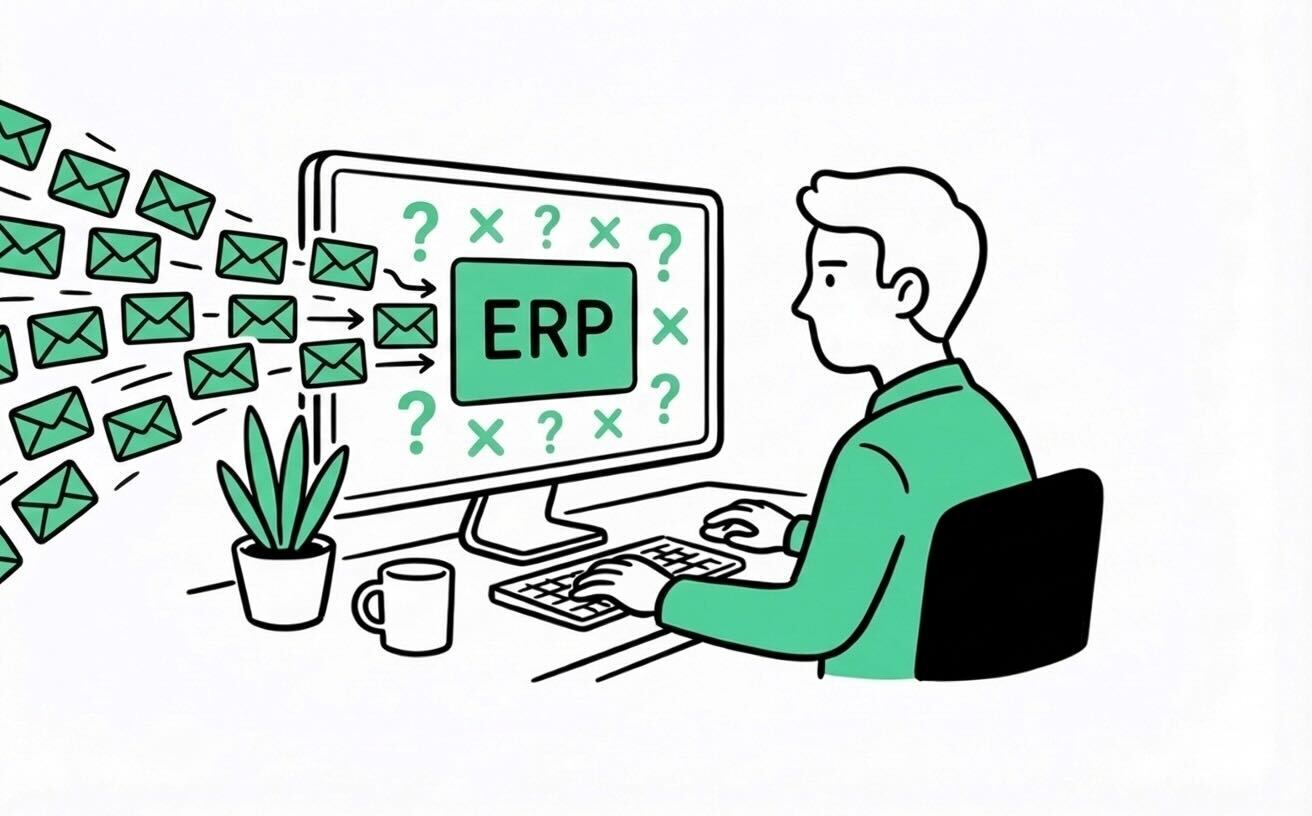
For the last two decades, supply chain tech experts have been predicting the "death of email." We were promised a future where every B2B transaction would happen seamlessly through slick web portals, EDI (Electronic Data Interchange) connections, or direct API links.
Yet, here we are. It is 2025, and if you walk into any sales administration office, you will see the same thing: screens full of Outlook or Gmail, bursting with new purchase orders.
Why has email survived? And more importantly, why does this simple communication tool cause such a massive headache for your advanced ERP system?
The Unstoppable Force: Why Customers Won't Quit Email
The reality is that email remains the dominant channel for B2B commerce, with over 376 billion emails sent daily worldwide. While web portals are great for browsing catalogs, they often add friction to the actual buying process.
For a procurement manager at your client’s office, logging into a unique portal for every single vendor they buy from is a nightmare. They have "portal fatigue." They don't want to remember 15 different passwords or learn 15 different checkout flows.
They want to work from their system, generate a Purchase Order (PO) as a PDF, and hit "Send."
It is Universal: Everyone has it. No training required.
It is Flexible: They can attach a PDF, a spreadsheet, or even a photo.
It is Human: They can add context ("Please deliver to the back dock this time") that a rigid portal checkbox can't capture.
Your customers love email because it is easy. But your ERP system hates it.
The Immovable Object: Why ERPs "Hate" Email
Your Enterprise Resource Planning (ERP) system—whether it’s SAP, Oracle, NetSuite, or Microsoft Dynamics—is a masterpiece of structure. It thrives on Structured Data.
It thinks in Rows and Columns.
It requires Exact Field Matching (SKU "A-123" must match exactly).
It operates on Binary Logic (True/False, In Stock/Out of Stock).
Email, by contrast, is Unstructured Data. It is conversational, messy, and variable.
When a customer sends an email saying, "Hey, I need 50 of those brackets we bought last March, and here is the PDF for the new project," your ERP sees nothing but noise. It cannot parse the body text to find the quantity. It cannot "read" the PDF attachment to find the SKU.
This fundamental disconnect—Unstructured Input vs. Structured Requirement—is the root cause of the fulfillment bottleneck.
The "Swivel Chair" Interface
To bridge the gap between the messy inbox and the rigid ERP, businesses invented a manual solution: The Swivel Chair Interface.
This is where a human sits between two screens. On the left screen is the customer's email (the messy order). On the right screen is the ERP order entry form. The human reads from the left and types into the right.
As we discussed in previous articles, this manual bridge is dangerous because:
It Violates "Garbage In, Garbage Out" (GIGO): Humans get tired. A typo in the SKU or price field contaminates your ERP data, leading to shipping errors.
It is Unscalable: When order volume spikes, you can't just "turn up" the typing speed. You have to hire more people, which kills your margins.
The Missing Link: A Translation Layer
You cannot force your customers to stop emailing you (they will just go to a competitor who accepts their emails). And you cannot "dumb down" your ERP to accept unstructured text.
You need a Translation Layer.
This is exactly where KadaSync fits into the architecture. We accept the "messy" reality of business email—the PDFs, the Word docs, the conversational body text—and we act as the universal interpreter.
Ingestion: We take the email in its native format (Universal Ingestion).
Translation: Our AI extracts the intent and the data (Structure the Unstructured).
Delivery: We hand your ERP the clean, validated JSON or XML file it craves.
By acknowledging that email is here to stay, you stop fighting against customer behavior and start automating it. The goal isn't to kill email; it's to make email machine-readable.